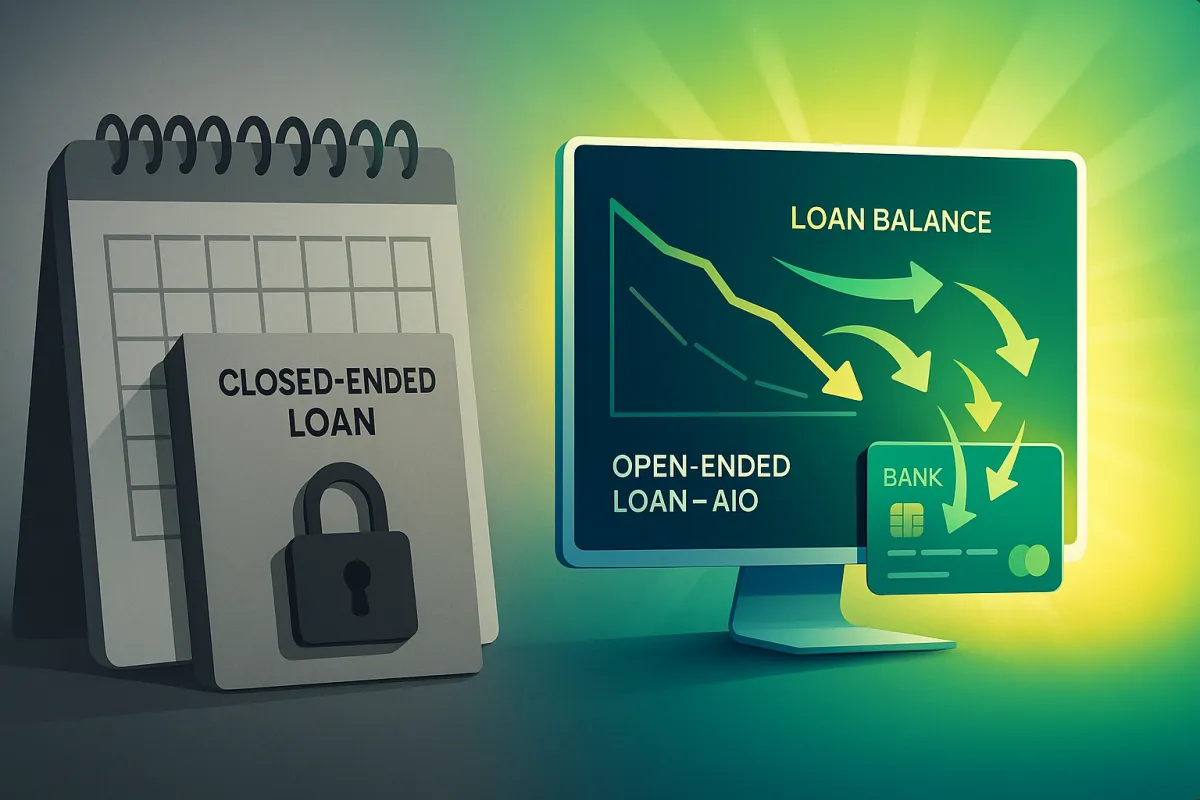
Open-Ended vs. Closed-Ended Loans: What They Mean and Which Is Smarter for Homeowners
Two Loan Types, Two Very Different Mindsets
When it comes to borrowing money, most people only think about the interest rate—but the structure of your loan matters just as much.
The big question? Are you using an open-ended loan or a closed-ended loan—and how does that impact your financial flexibility?
Let’s break it down in simple terms and see why the All-In-One Loan™ challenges the traditional system by giving borrowers more control.
What Is a Closed-Ended Loan?
A closed-ended loan is what most people have—a traditional structure where:
You borrow a fixed amount once.
You repay it over a set term (like 30 years).
Each payment includes both principal and interest.
Once it’s paid down, you can’t borrow again without reapplying.
Examples:
Standard 30-year mortgage
Auto loan
Personal installment loan
In short: It’s closed off after funding. You’re locked into a schedule, a term, and a long repayment timeline.
Why banks love it: Closed-ended loans are predictable cash machines. The structure ensures years of interest payments flowing to them—not you.
What Is an Open-Ended Loan?
An open-ended loan is flexible. It gives you ongoing access to borrowed funds—up to a certain limit—while you make payments and reuse available credit.
Examples:
Credit cards
Home Equity Lines of Credit (HELOCs)
The All-In-One Loan™
With an open-ended loan, you control how much you owe and when you access your funds. It’s revolving, not fixed.
Why borrowers love it: You can make deposits and withdrawals as needed. Your payments lower the balance, and that credit becomes available again.
Why the All-In-One Loan™ Is the Smart Hybrid
The All-In-One Loan™ takes the best parts of both worlds:
✅ It pays down like a mortgage,
✅ Functions like a checking account, and
✅ Recalculates interest daily to save you money.
Every time you deposit income, your balance drops. Interest is charged only on the remaining principal—so the faster your cash flow moves, the faster your debt disappears.
💡 Think of it as a built-in financial accelerator.
Example: Open vs. Closed in Real Numbers
Let’s say you have a $400,000 mortgage at 6%.
With a closed-ended loan, you’ll pay over $463,000 in interest over 30 years.
With an All-In-One Loan, the daily interest recalculation and income offset could cut that by more than half—and pay off your home in 12–15 years.
Same income. Same house. Smarter structure.
Why Most People Stick With Closed Loans
Simple—it’s what banks promote.
Closed-ended loans benefit the lender, not the borrower.
They’re easy to understand and guarantee decades of profit.
Open-ended structures like the AIO require a shift in mindset—from being a borrower to acting like a strategist.
Conclusion: It’s About Efficiency, Not Just Interest
Understanding the difference between open-ended and closed-ended loans is the first step toward financial independence.
If you value flexibility, control, and efficiency, the All-In-One Loan™ isn’t just “different”—it’s smarter.
Why stay locked into a loan that serves the bank when you could have one that serves you?
